

The five expense layers track what repeats—your ongoing cost of living. But some money moves to a different rhythm. It doesn’t belong in the baseline, not because it’s unimportant, but because it operates on different rules.
I call this The Life-Force Space. Often, this is where the largest and most meaningful financial decisions and forces of life happen.

I learned this through time. Folding irregular or structural spending into my layers made my baseline a mirror of worry, not reality. Keeping them separate left me with a clean €880 that actually reflects my recurring life. Everything else lives in The Life-Force Space. Once that boundary is set, the rest sorts itself.
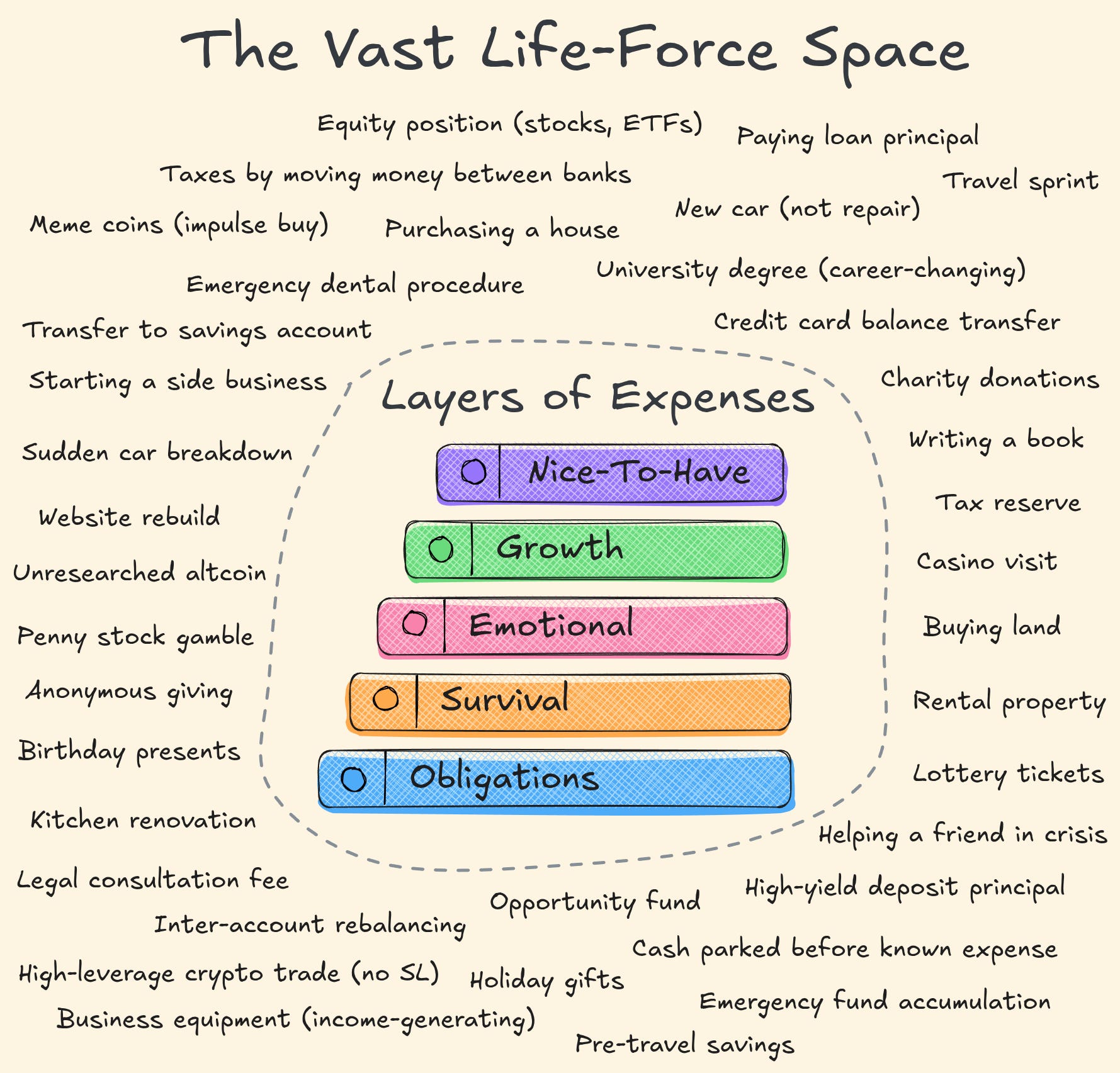
Here are the seven types of spending that naturally live in this space — outside the five layers, but essential to a complete financial life:
1. One-offs
Unexpected, non-repeating expenses like emergency repairs or unplanned medical bills. They arrive without warning, demand attention, then disappear — never to follow the same script twice. In my practice, emergency dental work stayed outside: amortizing it into monthly layers didn’t smooth reality, it smoothed anxiety.
2. Projects
Temporary, goal-bound spending like renovations, certifications, or travel sprints. They have a beginning, a middle, and an end. They draw from surplus, create momentum, then quietly exit — leaving your baseline untouched. My move from Latvia to Georgia was a project: intense, finite, and tracked separately.
3. Fundamental Investments
Capital that reshapes your structure: buying property, a vehicle, or education that shifts earning capacity. These aren’t expenses — they’re infrastructure. The asset itself stays outside; only its recurring costs enter the layers later. When I bought land, it didn’t raise my €880 baseline — it created a parallel track for maintenance and taxes.
4. Gifts
Money that flows outward — family support, birthday gifts, charity. It leaves your account by choice, not requirement. I track support for family as intentional allocation, not as part of my cost of living. It enriches someone else’s baseline, not mine.
5. Speculative Bets
Hope-based allocation without a framework: impulse trades, lottery tickets, meme coins. No structure, no expected return — just possibility. I learned this after a -30% crypto move: without risk management, it’s not deployment, it’s consumption disguised as opportunity.
6. Internal Transfers & Debt Principal
Money moving between accounts or paying down loans. It doesn’t leave your ecosystem — it just changes form. Layers track what exits to sustain life; transfers adjust the balance sheet. In Georgia, deposit interest is taxed automatically; the principal just waits, untouched by the layers.
7. Buffer & Savings Build-Up
Capital parked for future use: emergency funds, pre-expense accumulation. Not spent, not deployed — just waiting. They don’t maintain or change your baseline; they sit in the wings. My high-yield GEL deposits grow quietly outside the system, ready for deployment when alignment appears.
8. The Unscripted
All the other costs driven by life itself: circumstance, fleeting moments, or pure gut feeling. Unlike reactive emergencies, this is the capital of spontaneous creation. It’s the money spent to say “yes” to an unexpected opportunity, a sudden creative urge, or a moment of pure joy. We are creating our lives all the time, and this space holds the resources for that beautiful, continuous improvisation.
The five layers show what it costs to keep your life running as it is. The Life-Force Space tracks what it takes to reshape it, share it, or step into something new.
For some, this space is thin. For others, it is thick.
Keeping them apart doesn’t diminish either — it just gives each its proper rhythm. The layers are your operating costs. The Life-Force Space is where you invest in becoming who you’re meant to be.
Track them separately. Let them all live.
Illustration by Valters Šverns
May your day move at its own proper rhythm.