


When the drawing of my expense layers is finally finished, I see myself reflected in the ink. It becomes more than a ledger; it is a visual record of creation — volume distributed across different facets of my life, catching shifting lights.

The result serves as a simple map. It strips away my assumptions about my habits and reveals how I actually live.
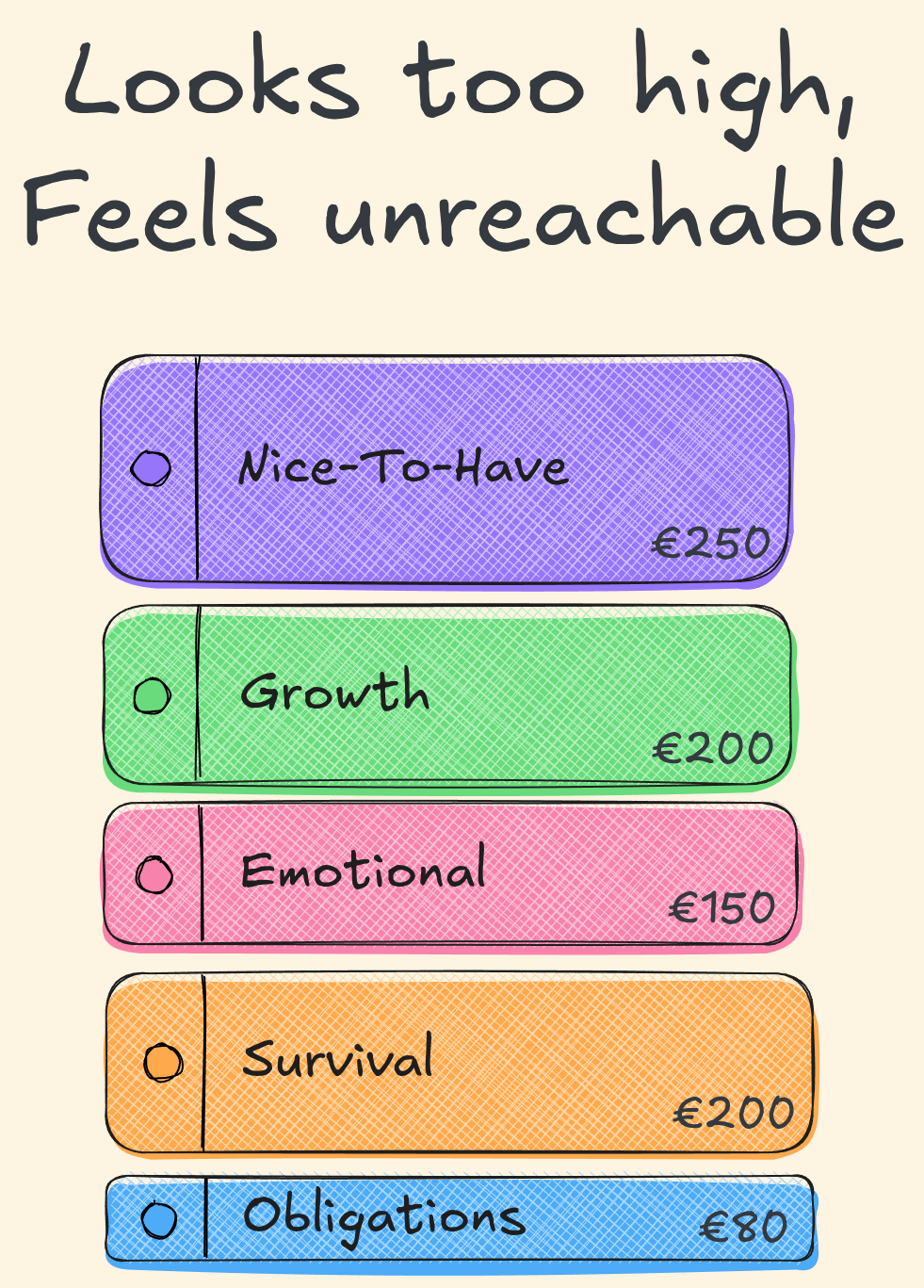
The Impossible Height
My first instinct is to draw my expenses as a vertical stack, one block resting heavily on the next. Each block is drawn to its exact proportion, yet the resulting tower looks impossibly high. It feels unreachable.
The Dangerous Incline
Trying to fix the height, I next try a steep, continuous incline that narrows into a slight pyramid. Where the first version was a sheer wall with no slope, this one offers multiple sides to choose from. It suggests options, a way to go around. But the total volume remains exactly the same, and the geometry is still unforgiving. It looks treacherous—a precarious form that feels dangerously unstable from every angle.
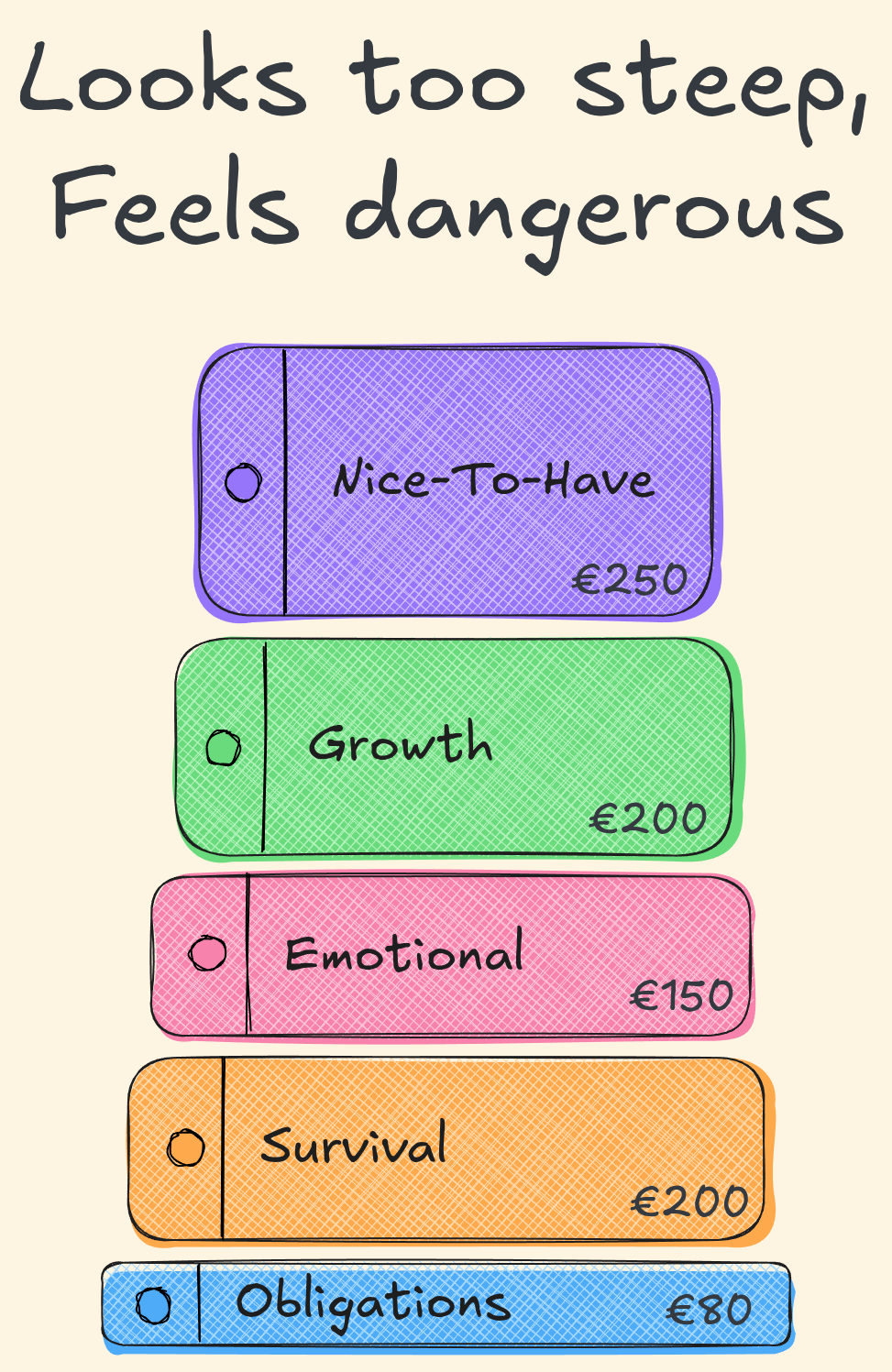
Both of these initial shapes demand a rigidity I do not possess. They manufacture a profound sense of scarcity before a single bill is even paid.
The Reachable Steps
The solution is to carve sensible, stepped layers into the shape. The volume of the blocks is identical to the first two attempts, but the geometry changes everything. Suddenly, it seems doable. It feels reachable.
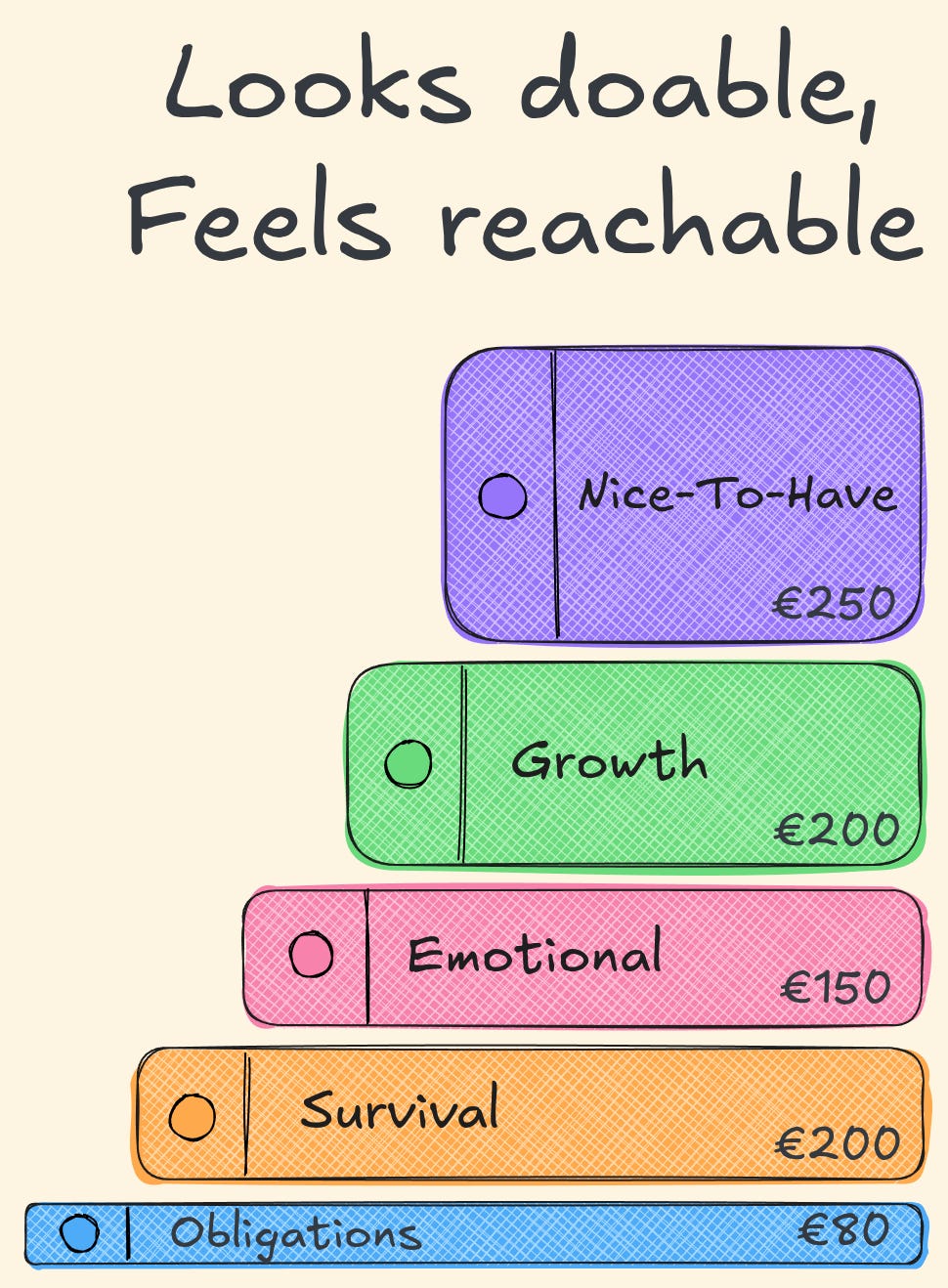
Sketching these proportions forces a confrontation with reality. I do not need laser precision — just enough contrast to see the ratios between the layers.
When one layer dwarfs the rest, I shrink the entire drawing vertically to keep the scale honest. The remaining blocks become paper-thin. This visual squeeze makes the imbalance tangible, revealing exactly how little space those smaller pieces actually occupy in the landscape of my days.
How do you know when this adjustment is necessary? Look at the extremes. Compare your largest expense (say, 250) to your smallest (80). If the gap between them is vast, scaling the drawing becomes essential. It also ensures the entire structure fits on the page.
The exact numbers on the page are merely an anchor, included to ground the drawing in the reality of my own life. But the math itself is secondary. Multiply those figures by a thousand or divide them by ten; the underlying geometry remains exactly the same.
What matters is the proportion, the rhythm, the symmetry, the shape. These relationships reveal more than any sum ever could. Ultimately, what I spend my money on is what I create. The drawing becomes a quiet blueprint of my individuality.
The Foundation First
The sequence of these layers dictates how I function. I anchor the base with obligations — bills, taxes, and the logistics of daily life — capped by survival: food, heat, and shelter. Building upward before this foundation is secure invites immediate collapse, whether through debt, fines, or a hollowed-out body.
Only when the base is solid do the higher layers emerge. Emotional needs refresh the mind, and comfort smooths the edges of the day. They may not be strictly mandatory for survival, but they are deeply felt.
Illustrations by Valters Šverns
The paper holds the volume of these choices in simple ink. A quiet architecture waits for anyone willing to trace it. And within the proportions of the page, a personal rhythm finally finds its footing.